| . | . | . |
|
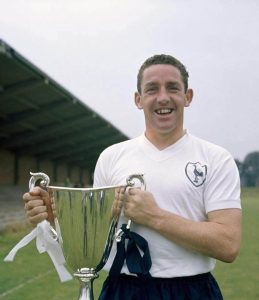
DAVE MACKAY – HEARTS AND FLOWERS 03.03.2015 When the news came through that Dave Mackay had passed away in a medical centre in Nottingham, it was hardly conceivable. The fact that a man who could run through brick walls and was as hard as they came, had been taken from his family and those who knew him and knew of him was hard to take in. But Dave had not been well for some time and at 80 years of age and despite winning many battles on and off the football pitch, this was one he could not come through.
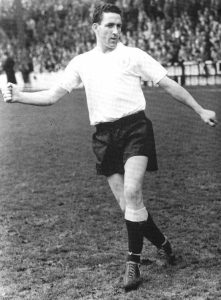
He was a player who was a major contributor to the Hearts side of the early 1950s that won their first Scottish Championship. The team has been hailed as the best in the club’s history and friends who support Hearts tell me of the stories they were told by their fathers of the fantastic way Mackay ran the midfield for Hearts. It was something that Bill Nicholson spotted and made him a player he was desperate to bring to the Lane. And once he did, you could see why. Tottenham were in a relegation battle and there was probably nobody more then Dave Mackay you would want on your side in such a position. Needless to say, he was instrumental in pulling them out of the fire and his fierce determination was to lead to greater things. At Hearts, he travelled to play for the club while away on National Service. Nothing would stop him playing football. And his drive to be the best he could be produced the stories of him relentlessly training in the old ball courts at Tottenham, smashing a ball against the walls with his left foot for hours to perfect his use of that foot and make it as good as his right. While he was a giant looking midfielder, he was only 5′ 7″ tall but his stature in the game grew with every game he dragged Spurs through. He had played at the 1958 World Cup, with Scotland and the way he carried himself during the 90 minutes he was on the football field lead by example to others who might not have his hunger for glory. And it was with Tottenham that perhaps his greatest glory was achieved. A crucial figure alongside Danny Blanchflower in Tottenham’s Double winning side of 1961, he is often seen as the artisan to Blanchflower’s artist, but Mackay’s skills should not be overlooked. Too often he is portrayed as a tough-tackling, no-nonsense ball-winner, but while he was that, there was much more to his game. His accuracy and range of passing was second to none and he was good from dead ball situations or putting the ball in from wide positions. His hard work made it easier for the likes of John White and Cliff Jones to flourish and he provided protection for them as well as his back three. But the sight of newsreel films showing Dave ploughing through the mud to hit a scorcher of a shot into the top corner are only scant Playing a part in all but the final in the year Spurs won the Cup Winners Cup, Mackay would have been heartbroken not to have been part of the team that actually won the first European trophy in Britain, but the next time Spurs picked up silverware, it was he who did so, lifting the FA Cup at Wembley in 1967, following a 2-1 win over Chelsea. Collecting medals was becoming a way of life, but when Bill Nicholson decided he needed to freshen up his team, he allowed Dave to move on to Derby County in 1968. Probably seeing Steve Perryman coming through the youth ranks, Bill Nick might have had him down as a straight replacement for Mackay and he did go on to be a Spurs legend in his own right, but there was still life in the old man yet !!
After a fourth place finish, a European Cup campaign that ended at the hands of Real Madrid and an FA Cup semi-final, the 1976-77 season started disappointingly, so he was sacked. However, his reputation earned him a job at Walsall, then he went on a tour of Britain and the Middle East to take his knowledge to other clubs. He retired from management in 1997. Dave was not a frequent visitor to White Hart Lane in his later years, but when he did come back, he always received a fantastic reception, from children who’s father or grandfathers had told them exactly how good he was … and he was one of the best. There is nobody in the current game who you could compare to him. Nobody comes close. He was unique and footballers nowadays would not have played while doing National Service. They probably wouldn’t even have done National Service. And there was few who would stay behind after training to improve their weaker foot. But if they had seen the man in his prime and seen what he had won in the game, then perhaps there would be more who would follow his example. As a man, a footballer and a leader, Dave Mackay stood taller than his 5′ 7″ frame. Puffing out his chest made him the equal of any opponent. His achievements rank up there with many others who have been feted more than the former Spurs captain, but the sight of him running out of the tunnel at the old White Hart Lane down towards the Park Lane end, with the brown leather ball tucked under his arm, will live in the memory and you just knew that in the coming 90 minutes, he would give everything he had. MEHSTG sends it’s condolences to Mr. Mackay’s family and friends at this sad time. Marco van Hip |
||
| . | . | . |
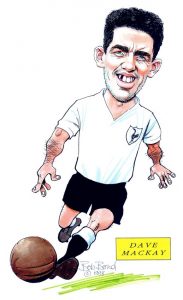 “Legend” is a term used far too freely in football these days. You only have to score a memorable goal or play 100 games for a club and the “legend” tag is stuck next to your name with ease. The tributes that have been paid to Dave Mackay from not just Heart of Midlothian, Tottenham and Derby County, but from all the other clubs he played for or managed, as well as other leading figures in the game who were not that closely connected with him show that he was a player who was revered throughout the sport.
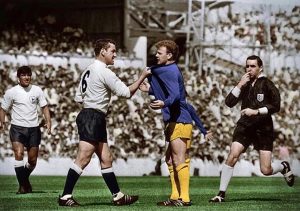 testimony to his ability. Coming back from two broken legs – one in the reserves, just as he was returning from the first break at Manchester United in the European Cup Winners Cup, when he tried to play on – he faced Leeds United and their niggly, cynical tactics brought about one of the most iconic images of the 1960s. With Dave grabbing Billy Bremner by the scruff of his shirt, it looked like a wee man being put in his place. Mackay’s anger was real enough, with the Leeds man aiming a kick at his newly repaired broken leg. Bremner looks like he is about to burst into tears, but Mackay was just making it clear to the fellow Scot that this was not the way the game was played. But he hated the photo as, being taken out of context, it made him look like a bully … and he had always fought against bullies.
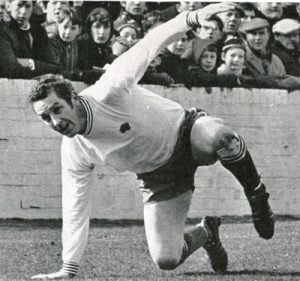 Brian Clough saw him as the man who could galvanise the side and hailed him as Tottenham’s greatest player of all time. Derby prospered from his experience and leadership, as they took the Second Division title in 1968 and that team went on to win the First Division Championship in 1972, but by that time Mackay had moved into management, while playing for Swindon Town. That was his education for a move to Nottingham Forest and then to take over from Clough, when he left Derby. Dave finished third in his first season and then, in 1974-75, he won the title with the club he had done the same with as a player.
| . | . | . |
|
DAVE MACKAY – LEADER ON AND OFF THE FIELD This article originally appeared in MEHSTG Volume 2 Issue 27 – August 2002 When I think back to the great Double side, the players just roll off the tongue … Blanchflower, Jones, White, Smith and so on. One man stands out as the really big influence on the side, one who would be arguably the one most missed if he was not in the team. He was not the team captain but he was the leader of the players both on the field of battle and their leader in play off it. That man is Dave Mackay. He was born in Edinburgh on 12th November in Edinburgh and he was the second boy in a family of four boys to a father who worked at “The Scotsman” newspaper. In his youth, Dave was quite small for his age and he played centre-half for his primary school before When Bill Nicholson was looking for a midfield player early in 1959, he initially focused his attention on Mel Charles of Swansea who was available for transfer. However, Mel chose to go to Arsenal and Nicholson turned his mind back to Dave Mackay, who Tommy Walker, the Hearts manager, had told him was not available. Bill was not deterred and he travelled up to Scotland to land his man on 17 March 1959 for £32,000. When Bill Nick was on the station platform at Edinburgh before he travelled back, the station manager enquired what he was doing there. When Bill told him that he had signed Dave Mackay, the stationmaster was shocked and it made Bill realise that he had signed a hero there. Dave made a quick impact at Tottenham and Spurs did not lose any of their eight remaining games that season when Mackay joined, although Dave only played in four because of injury. He admitted to Danny Blanchflower that he was not quite fit, but told him to watch him go during the next season. Bill noticed how Mackay lifted the whole place by his very presence and enthusiasm. His commitment and drive stirred up the players at the training ground and suddenly the training routines at Spurs became just as important as the matches themselves. He loved practising his skills and he gave everything in full-scale practice matches and six a side games. On the field, Dave showed bravery in his tackles as well as accuracy. He was an expert in the sliding tackle and despite his commitment and ferocity of his tackling, Dave was scrupulously fair. He quickly formed a useful partnership with Danny Blanchflower in midfield at right-half and Dave at left-half. The Scotsman became so influential in midfield that he was happy to stay back when Danny prompted his forwards by his forays from midfield. Mackay was also brilliant in his attacking role, by urging on his team-mates with his driving forward runs. He had a powerful shot, which often took keepers by surprise and he was very flexible and adaptable as a player. He filled in at left back and inside left when required and wherever Dave played, Bill knew that Dave would do a good job. The manager thought that Dave was his best-ever signing and he admitted that Dave would have been his first choice as captain if he had not already got a great one in Danny.
Disaster was to follow in December 1963, when he broke his left leg in the same competition in the away leg against Manchester United. His leg was broken in two places and it was in plaster for sixteen weeks. When the plaster was eventually removed, his left leg was four inches thinner than his right leg; such was the muscle wastage he suffered. Mackay was determined to make it back and worked on his left foot by lifting a 15lb. weight on it for hours. Dave was out of action for ten months and he returned to action in a reserve match against Shrewsbury Town on 12 September 1964. Disaster struck again in that game, as he was injured in a tackle and X-rays showed that he had fractured the same leg. Bill Nicholson ensured that Dave did not put on so much weight while he was inactive this time. It was being suggested that he might not play again, but Dave was so determined to return and he did, missing just one game in season 1965-66 and scoring six goals. He had missed the whole of season 1964-65 and he was sorely missed, as Spurs could not regain former glories. Dave was now captain, as Danny had retired and he took over the role from Ron Henry. He was a true leader by name and by merit. The bravery and determination shone through and his two leg breaks left him with a slightly misshapen leg, which was visible, but it did not worry him or restrict his movement. Dave also became a reliable penalty taker for the side. Mackay led Spurs to new heights in 1966-67 when he captained the team to a third FA Cup win in seven seasons with a 2-1 win over Chelsea in the final. In a great, unbeaten run from 27 December, Spurs climbed the league to finish third on top of the FA Cup triumph. Dave was one of only two survivors in the Cup Final squad from the Double team. The Scot went on to play another 29 games in season 1967-68, before Bill let him go to Derby County in 1968 for £5,000, a greatly reduced fee in recognition of his tremendous service to Tottenham and so that he could do well personally out of the deal. Brian Clough played him alongside the centre-half and he was so influential that he won the First Division title with them the following season and he was voted joint Football Writers’ Association Player of the Year. He left Derby after making 122 appearances for them and he went to Swindon as player-manager in 1971. His next stop was at Nottingham Forest before returning to Derby in 1973 as manager and, typically of Dave, they became Champions the following year. Dave later went on to be a very successful manager in the Middle East. The lasting memory of Dave Mackay is as a winner. He led the Spurs team in The Bell and Hare in their after-match get-togethers and he was always the team leader on the field. Dave won trophies and he was a huge influence in the dressing room and in training and his drive, commitment and enthusiasm was infectious. When he first returned to White Hart Lane as a player with Derby County, he received a standing ovation from our fans lasting over five minutes. This was because he had been a wonderful player with great skill and commitment. He played 318 games for Spurs scoring 51 goals and Dave Mackay is an all-time Spurs’ great and it is hard to think of any Spurs player before or since with more drive, commitment and enthusiasm and courage and bravery. Richard Porter |
||
| . | . | . |