
This article was originally featured in MEHSTG Volume 1 Issue 6 – December 1990
| . | ||
|
479 games (4 as a substitute), 1 goal. Not the greatest goals per game ratio, but then did it need to be ? Two League Cup winners medals, a UEFA Cup winners medal and a UEFA Cup runners-up medal. If honours are the criteria of a successful career, then perhaps his wasn’t one of the greatest, but then again, better than most. Philip Beal. A player who graced the white shirt of Tottenham Hotspur with honour and distinction. Never a foot or word out of place. A man who had a job to do and did it. No fuss, no controversy, no banner headlines slagging off managers or opponents, no demanding a place in the England team. Simply, a player who knew his place and that was in the back four of a successful Spurs line-up in the late 60’s and early 70’s. As in the theatre, the footballing understudy can hang around for years before finally getting a chance to shine an the main stage. In Phil’s case, he was, perhaps, the undeclared understudy to two of the best players of their time. Signing professional forms for Tottenham in 1962, he had to wait in the wing(half)s while Danny Blanchflower led Spurs on from the Double and into Europe. But, he served his time and stepped into the place vacated by the captain to play his first match at Aston Villa, where we recorded a 4-2 victory. In and out of the side for that and the next season, he thereafter became a regular in the team. In those early years he gained England Youth caps, but the full honour eluded Phil. His position in the senior side was filled by Bobby Moore (who we all know a bout), who rarely missed a game and played almost the same time that Beal was at his peak. The closest he came was in 19~7, when he was tipped to take a full back berth in the national team, but he broke his arm shortly before the squad was announced and missed 3 months of the season when complications set in, causing him to also miss the Cup Final . The opportunity of an England cap never presented itself again and it is a tragedy that Phil was not allowed to test his skilled and cultured defending against international opposition. Certainly, during Spurs’ successful campaign and unsuccessful defence of the UEFA Cup in 1972, 1973 and 1974, Phil was never embarrassed by the strikers he came up against.
In those days, most defenders defended, but Beal’s ability to advance with the ball was one of the early exceptions. A solitary goal was his scant reward throughout his many games representing Tottenham Hotspur. That goal came in a home League match v QPR in January 1969, when his foraging run from his own half took him towards the Rangers penalty area. He released the ball to Jimmy Greaves and got a perfect return, which allowed him to delicately chip the ball over the advancing goalkeeper in off the crossbar. It was typical of the versatility of the man. He was the first Tottenham player to be awarded a testimonial whilst still playing and such an honour was not given lightly in those times. Just think of all the players who missed such generosity. On a Monday night in December 1973, Spurs faced the crack German side Bayern Munich in a match to pay tribute to a Player who had selflessly given sterling service to his club. It is quite disgusting that a paltry crowd of 19150 bothered to turn up to show their appreciation of Philip Beal. It is rumoured that a large loss was made on the night, because of the high demands that the Germans had asked for to ensure their appearance. The 2-2 draw was actually quite an entertaining game for a testimonial. However, it turned out to be the first of many ill-attended testimonials and benefit matches staged by Tottenham over the years. After leaving Spurs, Phil moved to Brighton where he played only a handful of games, before travelling to the USA to star for the Memphis Rogues. He returned to England to finish his distinguished career at Crewe Alexandra. The least that you could say about Phil Beal was that he gave everything in every game that he played for Tottenham Hotspur. Yet his quiet efficiency meant that his regularly consistent performances often passed without the adequate recognition that his dependable contribution deserved. Sterling Performance |
||
| . | ||
| . |
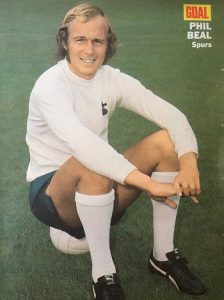 He was a player who could always be relied on too. If you saw the opposition’s forward streaking through the Spurs half, you somehow expected Phil to nick the ball off his toe or bring him crashing down with a perfectly fair, supremely timed sliding tackle. It wasn’t only the defensive side of his game which made him such a crowd favourite. His passing was accurate and of a quality which made the next move simpler for the receiving player. His pace was complementary to his ability to read the game, which allowed him to make important interceptions and then take the ball forward, thus turning defence into attack with great speed. The sight of his long (admittedly 1970’s) blonde hair flowing behind him was one to behold. Indeed, a sight recreated with almost stunning precision by Paul Walsh these days!.
This article originally appeared in MEHSTG Vol.2 Issue 24 – Xmas 2001
| . | ||
| PHIL BEAL – COOL, CALM AND SURE | ||
| When the great Danny Blanchflower was coming to the end of his career in 1963-64, a young defender had to step up from the Reserves to fill his boots. Phil Beal, a blonde 5 feet 9 inch rookie was the man who took his chance.
Born in Godstone, Surrey, Phil had gone on to play for Surrey boys and England Youth and he had signed as an amateur for Spurs in 1960 and become a professional in 1962. He made his first team debut in 1963 away to Aston Villa and went on to make 16 appearances for the first team that season which was the first season, for four years that Spurs had not won a trophy. Blanchflower had retired by the start of the following season and it was inevitable that the crowd would make comparisons between Danny and Phil. Initially taking the right-half berth, Phil was more defensive minded than Danny and many saw that he lacked the great skipper’s attacking abilities. With a lot of criticism facing Phil at a time of transition in Spurs’ history with both Bobby Smith and John White no longer around, Phil only made 8 appearances in 1964-65. Phil was to bounce back. He was very adaptable at a variety of positions and he filled both the right-half, the right back and left half roles admirably. He featured in 21 games in 1965-66 and he started in 26 games in the resurgence of Spurs in 1966-67. He did not make the FA Cup winning side of 1966-67 but was in both League Cup winning sides at Wembley against Aston Villa in 1970-71 and Norwich in 1972-73. He was also in the side that played both legs in the UEFA Cup Final against Feyenoord in 1973-74. He had fully established himself in the side in the late sixties and he only missed one game in the 1973-74 season and he consistently showed his calm, authoritative and composed style. A regular number 4 in the side by now, he was a good reader of the game and he frequently stopped opposing attacks by good timing rather than fierce tackling. Nevertheless, Phil could tackle well and he was a good distributor of the ball. He was very composed in his own half and invariably took the ball from Pat Jennings to start another Spurs ‘attack. Phil always seemed to have time and was a reassuring sight for Spurs’ fans and did not seem rattled and this must have inspired his fellow defenders.
Phil was also brave. In one game at Chelsea, Phil finished with both his arms and legs in bandages. He was so very committed and consistent. He finished his Spurs’ career in 1975. He had made 330 League appearances in his time from 1963-1975 and he had made 420 appearances in all competitions. His consistency and loyalty were without question and his perseverance in overcoming the early comparisons with the Double team were rewarded. After leaving Spurs, Phil went on to play for Brighton, Crewe, Los Angeles Aztecs and Memphis Rogues in the USA. He now works as assistant manager for a car rental firm at Heathrow Airport and he hopes to retire to Cornwall eventually. He had it all mapped out on the field and his plans off it seem similar. Phil missed out on the big money era of soccer and earned little from his testimonial having to pay expenses for the match. He was a fine player for Spurs who is fondly remembered. He played 30 games for Spurs in Europe and it was a shame that he did not reach full International honours. His only real weakness was in only scoring one goal for Spurs. It was as a defender that he excelled and he loved the game which he gracefully played for 12 seasons for the first team. Richard Porter |
||
| . |
 Beal was unlucky on two accounts. Firstly, he started in the team when the great Double side was breaking up and no matter how well he performed, he was always going to suffer by comparison to the outstanding players of that side, especially Danny and John White who both had superb attacking skills. Secondly, he was playing in the same era as the great Bobby Moore, the England Captain, so Phil was unable to get into the England set-up. In many ways, Phil was not unlike the West Ham captain as they not only played in the same position, but had similar styles in being composed on the ball with immaculate timing and appearing unhurried in their movements. This was because both players were such good readers of the game that they usually knew when to challenge and when to tackle and where to send attackers they were marking to ensure as little threat as possible to their own teams’ goals.